




Telescope 80mm Aperture Portable Refracting Telescope — Practical Review
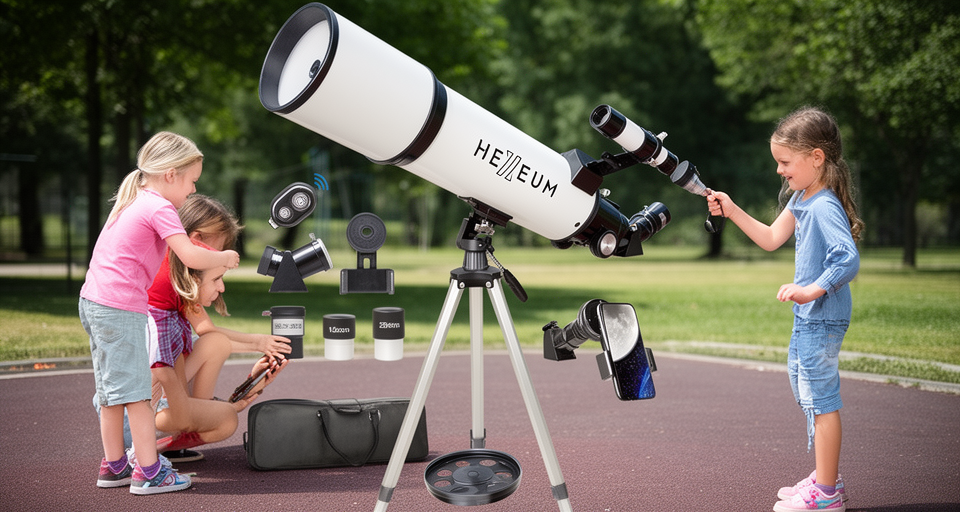
This 80mm aperture, 600mm focal length refractor is aimed at hobbyist stargazers who want a portable, ready-to-use scope. It ships with fully multi-coated optics, an altitude-azimuth (AZ) mount, a tripod, a smartphone adapter, wireless control, and a carry bag. Below I describe what this kit does well and where it falls short, based on typical user experience with similar beginner telescopes.
What it is and how it performs
The scope is a short-focus refractor with an 80mm objective. That aperture gathers a fair amount of light for views of the Moon, planets, and brighter deep-sky objects. The 600mm focal length yields a relatively wide field of view. Fully multi-coated lenses help with contrast and light transmission, so images appear reasonably bright for the size.
The AZ mount is intuitive. You move the scope up/down and left/right with simple controls. This makes initial setup quick. The included tripod is lightweight and makes the whole package easy to carry to a dark spot. The smartphone adapter allows simple daytime and lunar photography. Wireless control sounds modern and can simplify small adjustments without touching the OTA.
Pros
- Good portability — compact tube and a soft carry bag make transport simple.
- 80mm aperture gives decent views of the Moon and planets and some brighter nebulae.
- Fully multi-coated optics improve contrast compared with single-coated lenses.
- AZ mount is user-friendly for beginners and casual observing sessions.
- Includes tripod, phone adapter, wireless control and bag — useful starter bundle.
Cons
- Limited light-gathering compared with larger apertures — faint galaxies and nebulae remain challenging.
- AZ mounts are fine for visual use but poor for long exposure astrophotography or precise tracking.
- Eyepieces supplied with kit-level scopes are often basic; expect to upgrade for sharper, higher-contrast views.
- Some chromatic aberration can appear on bright objects because many 80mm refractors are achromatic designs.
- Tripod stability is average; wind or heavier eyepieces can introduce vibration.
Who should consider this telescope
This kit is well suited to beginners and casual observers. If you want to learn the sky, enjoy lunar and planetary viewing, or take simple smartphone photos of the Moon and bright objects, this telescope is a practical, cost-conscious choice. It is also a good option for families or as a first scope for a teen or child because setup is straightforward.
Who should look elsewhere
If your goal is deep-sky observing of faint galaxies and nebulae, consider a larger aperture reflector or a 100mm+ refractor. If you plan to do serious astrophotography, choose an equatorial mount with motorized tracking and a sturdier tripod. Advanced users will likely find the included eyepieces and mount limiting.
Short comparison with similar options
Compared to a 70mm beginner refractor, the 80mm model gathers noticeably more light and offers improved detail on planets. Versus a 102mm refractor, it is lighter and cheaper but will show less fine detail and weaker deep-sky performance. A 6" Dobsonian reflector of similar price will outperform this refractor on faint deep-sky objects because of its larger aperture, but it is bulkier and less suited to casual grab-and-go observing.
Final assessment and recommendation
This 80mm portable refracting telescope is a sensible entry-level instrument. It bundles useful accessories and focuses on ease of use. Expect enjoyable views of the Moon, Jupiter and Saturn, and some brighter nebulae under dark skies. Do not expect advanced astrophotography or deep-sky performance without upgrades.
If you are starting out and value portability, a simple AZ mount, and a ready-to-use kit with a phone adapter, this telescope is a reasonable pick. If your interests are deeper, consider investing in a larger aperture or a more stable, equatorial mount instead.